


Author: Tracy Durksen
Historically, efforts to reform schooling and transform educational practices in ways that support improved outcomes for Aboriginal1 students and their communities have largely failed.
Along with ‘reform fatigue’ we know teachers are also burdened with heavy workloads that are complicated further with ongoing staff shortages – all the while operating in an era of performative, standards-based professional learning with shifting requirements.
While governments are committed to reducing teacher workloads, their approach includes reducing the time and resources associated with lesson planning – the work most valued by teachers. Instead of a reduction, teachers want more time to do the intellectual work needed when preparing and planning to meet their students’ needs.
To do this well, teachers want to discuss contextually relevant and high-quality research about teaching and learning. Since scheduling sufficient time for such deep work is a significant barrier for schools, research use in professional learning may resort to surface, quick-fix approaches presented as watered-down ‘tips for teachers’ or ‘what works best.’
The Culturally Nourishing Schooling Project
Culturally Nourishing Schooling (CNS) is a whole-school reform project led by Professor Kevin Lowe with the goal of changing schooling practices to improve outcomes for Aboriginal students.
For the past 4 years, the CNS team has engaged teachers in place-based professional learning and witnessed the struggles as schools and communities tried to carve out the time required for the complexities of whole-school reform work. For example, participation was often interrupted, particularly within rural and remote schools, given the lack of casual teachers available to release class teachers for professional learning.
Professional learning conversations among Aboriginal educators, teachers and school leaders are a key strategy within the CNS project – one that involves a series of conversations about scholarly research and supports school communities as they seek a deep understanding of what it means to be a culturally nourishing school. Instead of quick tips, teachers are challenged to critically reflect on their own identity and how it potentially influences their personal bias and worldview while operating within colonial schooling systems.
However, even finding time to complete the pre-conversation readings was challenging for most teachers.
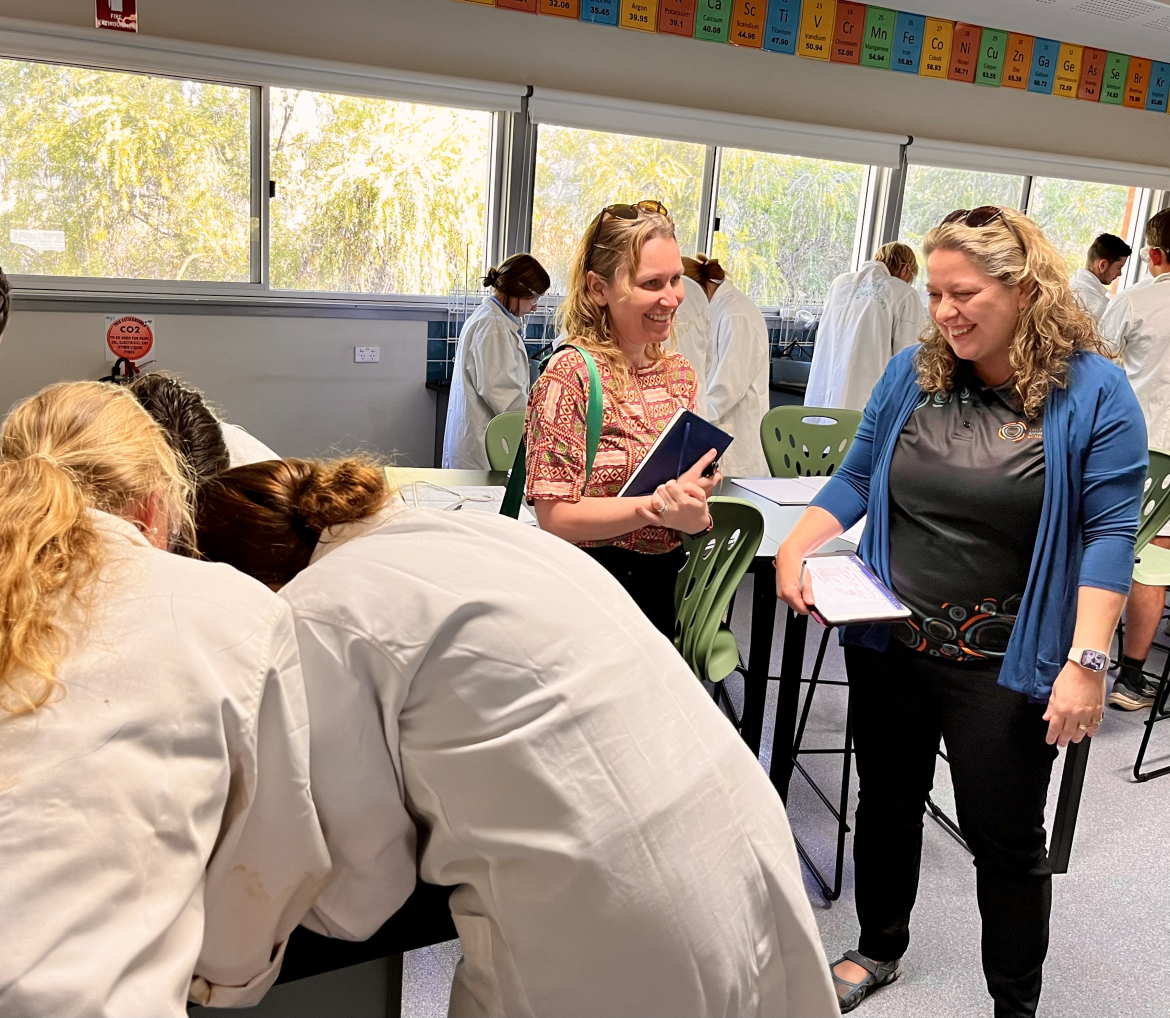
CNS Researcher Tracy Durksen (R) with CNS Pedagogical lead Mary Kite onsite working
Professional Learning Conversations
“When I first heard about it, I was like…where do I have the time to do this? …then once I read the readings…and reflected on the kids and my role at school, it was kind of more of a why not am I doing this?”
In our recent study led by Dr Claire Golledge, we report on 1 year of conversations prompted by a selection of high-quality journal articles. Alongside 1-2 other researchers, I helped facilitate 6 conversations (online or in-person) with a collective including 1 Cultural Mentor, 1 principal, and 11 teachers (primary and secondary) from two schools in one remote NSW community. With the aim to develop a common language and build a cultural body of knowledge, we used open-ended reflective questions like What are the key messages of the reading? and What are the implications for your practice? along with topical provocations.
As expected, conversations highlighted the impact felt by staff from the lack of time and resources available to confidently implement culturally nourishing practices in their schools. These conversations also provided a space for teachers to challenge and rethink entrenched practices that disadvantage Aboriginal students.
Overall, we found the conversations fostered a collective understanding of the moral purpose in their work and allowed for critical examinations of existing practices. Through these conversations, teachers like Irene2 were able to engage directly with what she considers to be the underlying purpose of education:
“…the vast majority of teachers certainly come to the task of teaching with a really strong sense of moral purpose. I am an optimist when I think of, you know, teachers doing this moral work and, you know, the fact that education…is one of the really deeply moral and ethical practices of a nation in terms of how it wants a future generation to understand and to view the world…”
The scholarly readings emphasised the importance of building strong relationships with Aboriginal students and communities, while at the same time grappling with the challenges posed by existing school structures. For example, Emma experienced her strong moral purpose as “eroded” because of the pressures of a schooling culture of compliance and accountability – something she described as the antithesis of the “human connectedness” critical for relationships with staff, students, and communities.
The conversations highlighted a need for time spent on understanding the historical and ongoing impacts of colonialism on educational practices. Through the conversations, teachers contended with Aboriginal concepts and questioned the existing schooling practices. By the final conversation of the year, Irene had broadened her view of the challenges facing her students to consider the broader structure and system she was working within, arguing:
“we should think about the current structure of schooling and how it can be improved to benefit everyone in the community…”
For Irene, this was a shift from focusing solely on individual families or students and instead recognising the school’s responsibility to the wider community and an awareness of how little the needs of the community are measured or valued in the existing metrics of school success and resourcing. Over time, developing a deeper understanding of Aboriginal concepts and perspectives became central to their conversations.
Fostering collaborative relationships for collegial and challenging conversations requires deep place-based work and time. In my previous research, teachers reported collaborative professional learning as having the most impact on their self- and collective efficacy beliefs – that is, their confidence in their abilities and in their school to influence student learning. Through our recent study led by Scientia Professor Andrew Martin we found that Australian teachers’ self-belief in being able to teach Aboriginal perspectives in the curriculum was associated with greater valuing of Aboriginal students’ capacity to engage in learning. Teachers’ self-belief was also associated with Aboriginal students being more interested and more confident in their learning.
It's Time to Make Time for Teachers
Prioritising sustained efforts for supporting teachers with quality professional learning time is essential. This includes developing meaningful opportunities for teachers to engage with scholarly research and have critical conversations in their local context. With the the professional learning conversations and other key strategies enacted through the Culturally Nourishing Schooling project, there is potential for collaborative practices to significantly transform schooling practices for Aboriginal students – it’s overdue and a matter of time.
[1] The term “Aboriginal” is used here because it is the dominant or preferred term of particular communities involved in the Culturally Nourishing Schooling Project.
[2] Pseudonyms are used in this article